-
8/6/26, 4:00 PMPoster SessionPoster
Submarine canyons found along the continental shelf of the New York Bight (NYB) are highly dynamic, interconnected ecosystems that serve as critical deep-sea biodiversity hotspots. These deep-sea habitats are increasingly vulnerable to anthropogenic stressors, including commercial fishing, coastal pollution, ocean acidification, and hypoxia. Direct, continuous observation of these remote...
Go to contribution page -
8/6/26, 4:00 PMPoster SessionPoster
The mechanisms by which plants coordinate intracellular calcium (Ca²⁺) signaling with extracellular Ca²⁺ availability, ion homeostasis, and nutrient compartmentalization remain an open question. In Arabidopsis, ACA8 and ACA10 are two major plasma membrane-localized autoinhibited Ca²⁺-ATPases that mediate Ca²⁺ efflux from the cytosol and altered ACA8 and ACA10 activities leads to changes in...
Go to contribution page -
50. Identification and characterization of putative mitochondrial copper transporters in ArabidopsisOlena Vatamaniuk (Cornell University), Xing Liu8/6/26, 4:00 PMPoster SessionPoster
Copper (Cu) is an important micronutrient essential for plant growth, development, and reproductive success. In recent years, significant progress has been made toward elucidating the mechanisms of copper uptake and transport in plants. However, many gaps remain in the intracellular trafficking of Cu. In mitochondria, Cu is indispensable for mitochondrial respiration as a cofactor of electron...
Go to contribution page -
8/6/26, 4:00 PMPoster SessionPoster
Fish bodies contain numerous sclerochronological structures that have been used for routine age determination (from annual increment deposition) and increasingly, to study elemental and isotopic composition for life history interpretation. The most widely used structures are otoliths (literally, ear-stones), made of aragonite (CaCO3) precipitated on a protein framework, that are part of the...
Go to contribution page -
8/6/26, 4:00 PMPoster SessionPoster
It has been known for decades that micronutrient copper is essential for plant growth, development, fertility, and seed yield. However, which plant reproductive organs require copper, how copper is delivered to these structures, and how it acts to ensure fertility is not entirely understood. In this poster I will present my research findings as well as some previous investigations done in the...
Go to contribution page -
8/6/26, 4:00 PMPoster SessionPoster
Beneficial root–microbe interactions enhance plant growth and stress resilience, including the establishment of a primed immune state known as Induced Systemic Resistance (ISR). Although ISR is typically assayed through leaf responses, its establishment begins in roots, where the cues that gate successful systemic protection remain poorly understood.
Iron (Fe) is a key element for ISR...
Go to contribution page -
8/6/26, 4:00 PMPoster SessionPoster
In the last few years, the LiX beamline at NSLS-II has developed capabilities for scanning imaging and tomography based on both scattering and fluorescence contrasts. This is accomplished using fly-scanning with a typical beam size of 5 microns, and simultaneous data collection on a pair of Pilatus detectors (Dectris) for small- and wide-angle X-ray scattering, as well as two two-channel...
Go to contribution page -
8/6/26, 4:00 PMPoster SessionPoster
Woodchip samples with varying ferrihydrite surface coatings were incubated under different bulk redox conditions to investigate how iron availability and redox fluctuations affect localized redox gradients and hotspots. The spatial distribution of iron oxidation states in these samples can help identify reducing zones in the wood, with potential implications for understanding the effect of...
Go to contribution page -
8/6/26, 4:00 PMPoster SessionPoster
The Extremely Brilliant Source (EBS) of the European Synchrotron Radiation Facility (ESRF) is the world’s premier fourth-generation high-energy synchrotron source, offering remarkable flux and coherence that have enabled an unprecedented enhancement in experimental throughput. The ID21 beamline is dedicated to micro- and nano-X ray spectroscopy, offering 2D X-ray fluorescence (XRF) mapping and...
Go to contribution page -
8/6/26, 4:00 PMPoster SessionPoster
The demand for uranium (U) has surged due to its role in nuclear energy, agriculture, mining, and military defense. This widespread use leads to uranium entering aqueous environments, raising concerns about its impact on public health and wildlife. In the United States, the tolerance limit for U in drinking water is set at 30 ug/L, with ground water exhibiting the higher concentration of U,...
Go to contribution page -
8/6/26, 4:00 PMPoster SessionPoster
The electrochemical conversion of urea rich wastewater into value added products presents a promising strategy for sustainable water treatment, energy generation, and resource recovery for long duration space missions. In this work, boron-doped diamond (BDD) electrodes sequentially modified with nickel and platinum nanoparticles were developed to investigate enhanced urea oxidation and...
Go to contribution page -
8/6/26, 4:00 PMPoster SessionPoster
X-ray-based imaging and spectroscopy are increasingly used to investigate the structure, elemental composition, and physiological processes of living plants. However, exposure to ionizing radiation can damage plant tissues and alter the biological processes being measured. The severity of these effects depends on factors including X-ray energy, photon flux, exposure duration, illuminated area,...
Go to contribution page -
8/6/26, 4:00 PMPoster SessionPoster
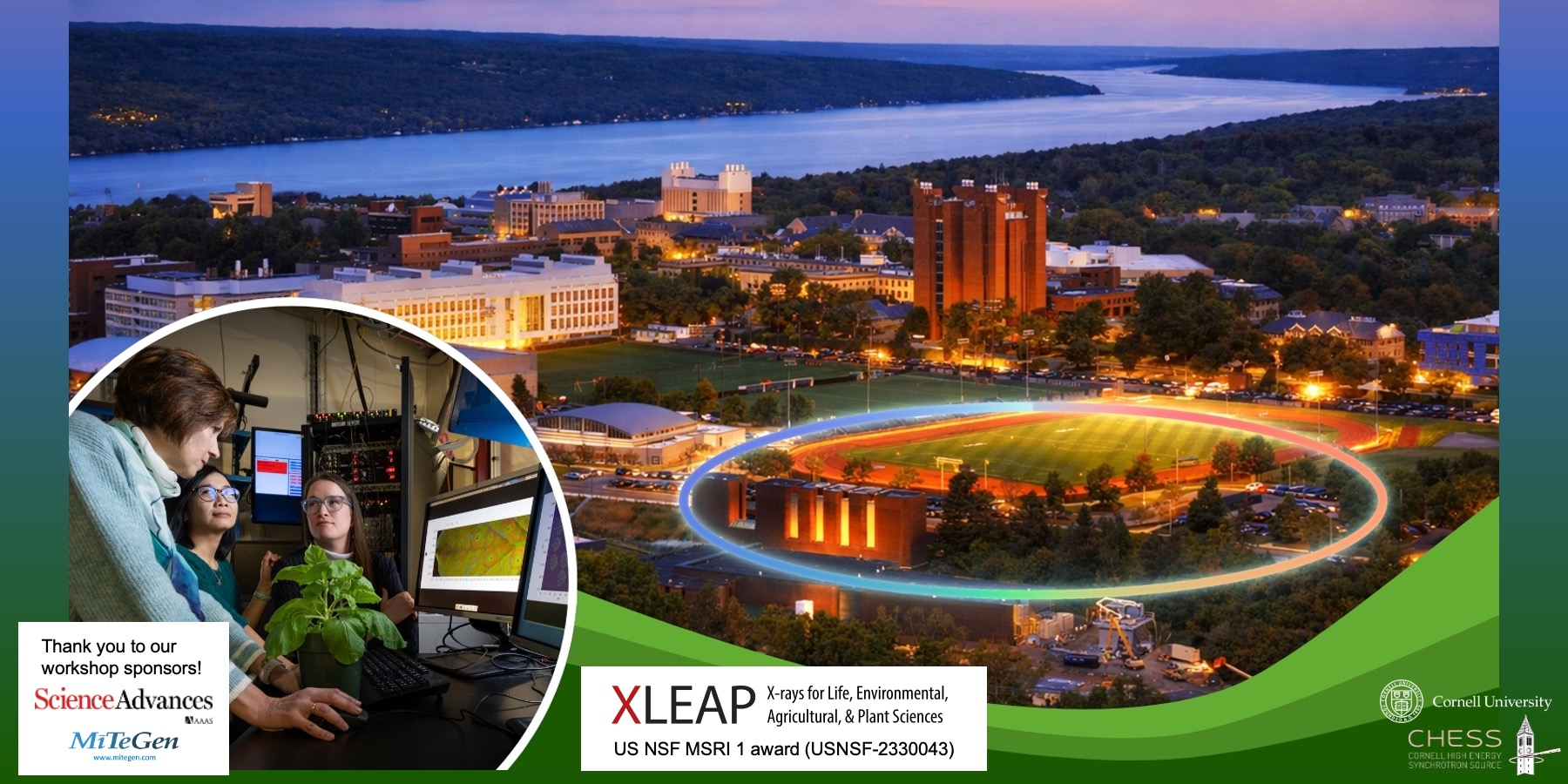
A new microfocus beamline entitled XLEAP (X-rays for Life, Environmental, Agricultural, and Plant Sciences) is under construction at the Cornell High Energy Synchrotron Source (CHESS). This mid-scale research infrastructure award (USNSF-2330043) began in April 2024, procurement and construction are under way, and the facility is planned to open for user operations in 2028. During construction,...
Go to contribution page
Choose timezone
Your profile timezone: